


In an ongoing Phase 2 study, NDV-01 has produced durable complete responses with a favorable safety profile – no ≥ Grade 3 treatment-related adverse events. Relmada believes NDV-01 has the potential to become a differentiated, bladder-sparing treatment option across multiple NMIBC settings.

NMIBC accounts for approximately 75–80% of newly diagnosed bladder cancer cases and is characterized by high rates of recurrence and long-term disease burden.
Despite initial treatment, 50–80% of patients experience recurrence, and up to 10–20% of high-risk patients may progress to muscle-invasive disease. As a result, NMIBC requires ongoing surveillance and repeated intervention creating a significant burden for both patients and healthcare systems.
NMIBC treatment is guided by risk stratification and aims to prevent recurrence and progression. Most patients begin with transurethral resection of the bladder tumor (TURBT), followed by risk-adapted intravesical therapy.
For high-risk disease, intravesical Bacillus Calmette–Guérin (BCG) remains a standard of care, but a meaningful proportion of patients are intolerant or become unresponsive, limiting its long-term effectiveness. For these patients, options narrow to radical cystectomy or bladder-sparing approaches such as intravesical chemotherapy, gene therapy, or immunotherapy.
Conventional Gem/Doce has been used in the academic setting as an effective intravesical therapy across multiple risk settings, with demonstrated activity in both BCG-unresponsive and BCG-naïve disease. But its administration is operationally complex and produces variable drug exposure—creating an opportunity for a better delivery approach.
Conventional Gem/Doce is well known and widely used, but operationally complex – a roughly four-hour procedure requiring specialized pharmacy preparation, which has largely confined its use to academic centers. NDV-01 is engineered to change that, pairing a clinically validated backbone with a sustained-release delivery platform built for real-world use.
From four hours to five minutes. Two prefilled syringes, instilled in-office in under five minutes. No pharmacy preparation, no anesthesia, no specialized infrastructure.
Built for the community setting. Simple administration by an MA, RN, or LPN is designed to bring Gem/Doce to the community urology practices where approximately 80% of NMIBC patients are treated.
Sustained tumor exposure. NDV-01 delivers continuous Gem/Doce release for up to 10 days via a biodegradable polymer matrix that safely disintegrates and clears in urine – no device extraction required.
Clinically de-risked. By building on urologists' established familiarity with conventional Gem/Doce, NDV-01 reduces mechanistic and regulatory risk while introducing a meaningful delivery advantage.
NDV-01 is a rapid, in-office therapy that requires no specialized pharmacy preparation, cold-chain storage, specialized equipment, or complex handling.

Gel A: hydrophilic gel is instilled into an empty bladder via catheter

Gel B: hydrophobic reservoir (matrix) containing the drugs is released within the gel

The gel is washed out in urine within hours
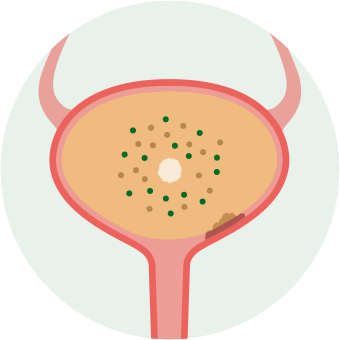
The matrix gradually releases the drugs into the bladder for up to 10 days
In an ongoing Phase 2 study in high-risk NMIBC, NDV-01 demonstrated durable efficacy alongside a favorable safety profile:
95% complete response (CR) rate at any time and a durable 76% CR rate at 12 months in high-risk NMIBC
94% CR rate at any time and 80% CR rate at 12 months in BCG-unresponsive patients
No patient progressed to muscle-invasive disease, and no patient underwent radical cystectomy
No ≥ Grade 3 treatment-related adverse events, and no treatment-related discontinuations or dose interruptions
Taken together, these data reflect an unusually clean safety profile alongside durable, clinically meaningful responses – including in the difficult-to-treat BCG-unresponsive population. This profile supports NDV-01's advancement into the Phase 3 RESCUE registrational program.
NDV-01 is advancing into the Phase 3 RESCUE registrational program, expected to initiate upon IND clearance, with two independent, complementary pathways:
1. Second-line BCG-unresponsive NMIBC (CIS ± Ta/T1) – ~5,000 patients/year in the US
Single-arm trial in 2L BCG-unresponsive NMIBC with CIS, refractory to approved or developmental first-line therapies
Primary endpoint: complete response rate at any time
An efficient path to approval in a high-unmet-need population where patients often face radical cystectomy – enabling early adoption and real-world physician experience
2. Adjuvant intermediate-risk NMIBC – ~75,000 patients/year in the US
Open-label, randomized controlled trial of adjuvant NDV-01 following TURBT versus surveillance
Primary endpoint: disease-free survival (DFS)
Targets a large, underserved patient population with no approved therapies, representing a significant commercial opportunity for broad adoption
Targets a large, underserved population with no approved therapies—a significant commercial opportunity.
View the trial on ClinicalTrials.Gov.
With approximately 80% of NMIBC patients treated in community settings, NDV-01 has the potential to bring a highly effective Gem/Doce combination beyond academic centers. By combining clinical familiarity, operational simplicity, and scalable delivery, NDV-01 is built to drive broad adoption across real-world urology practice.


