Relmada Therapeutics, Inc.
A Next-Generation Intravesical Therapy for NMIBC

NDV-01 is a sustained-release intravesical formulation of gemcitabine and docetaxel (Gem/Doce) in development for the treatment of non-muscle invasive bladder cancer (NMIBC). Built on a chemotherapy combination familiar to urologists, NDV-01 is designed to prolong bladder exposure, support consistent local drug delivery, and simplify in-office administration of conventional Gem/Doce. Relmada believes NDV-01 has the potential to become a differentiated, bladder-sparing treatment option across multiple NMIBC settings.
The therapy enables prolonged bladder exposure and consistent local drug release for up to 10 days, supporting sustained tumor exposure while minimizing systemic toxicity. NDV-01 is administered as a ready-to-use product in <5 minutes, without the need for anesthesia or specialized equipment.
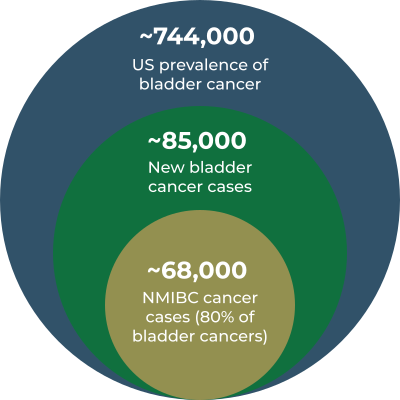
Non-Muscle Invasive Bladder Cancer (NMIBC)
NMIBC accounts for approximately 75–80% of newly diagnosed bladder cancer cases and is characterized by high rates of recurrence and long-term disease burden.
Despite initial treatment, 50–80% of patients experience recurrence, and up to 10–20% of high-risk patients may progress to muscle-invasive disease. As a result, NMIBC requires ongoing surveillance and repeated intervention, creating a significant burden for both patients and healthcare systems.
Current Treatment Landscape
The treatment of NMIBC is guided by risk stratification and aims to prevent recurrence and progression. Initial management for most patients includes transurethral resection of the bladder tumor (TURBT), followed by risk-adapted intravesical therapy.

For high-risk disease, intravesical Bacillus Calmette–Guérin (BCG) remains a standard of care; however, a meaningful proportion of patients are intolerant or become unresponsive, limiting its long-term effectiveness.
For these patients, treatment options are limited and may include radical cystectomy or bladder-sparing approaches such as intravesical chemotherapy, gene therapy, or immunotherapy. Emerging treatments and clinical trials continue to expand the landscape, aiming to improve outcomes while avoiding radical cystectomy.
Conventional Gem/Doce has already been utilized in the academic setting as an effective intravesical therapy across multiple risk settings, with demonstrated efficacy in both BCG-unresponsive and BCG-naïve disease.
However, conventional Gem/Doce administration is associated with workflow complexity and variability in drug exposure, creating an opportunity for improved delivery approaches.
NDV-01 is designed to build on this established backbone by enabling sustained drug release and simplifying administration, with the goal of improving consistency and real-world usability.
NDV-01 is Designed to Overcome the Limitations of Conventional Gem/Doce
Conventional Gem/Doce is well known and utilized but operationally complex – requiring 4-hour procedure, specialized pharmacy preparation, and limiting use primarily to academic centers.
NDV-01 is engineered to transform this paradigm by combining a clinically validated backbone with a novel, sustained-release delivery platform designed for real-world use.
From 4 Hours to 5 Minutes. Two prefilled syringes. In-office instillation in <5 minutes. No pharmacy preparation, no anesthesia, no specialized infrastructure.
Built for the Community Setting. NDV-01's simple administration by MA, RN, or LPN is designed to bring Gem/Doce to the community urology practices where approximately 80% of NMIBC patients are treated.
Sustained Tumor Exposure. NDV-01 delivers continuous Gem/Doce release for up to 10 days via a biodegradable polymer matrix that safely disintegrates and is excreted in urine – no device extraction required.
Clinically De-Risked. NDV-01 builds on the urologists established familiarity with conventional Gem/Doce, reducing mechanistic and regulatory risk while introducing a meaningful delivery advantage.

Phase 2 Clinical Data (12-Month Follow-Up)
NDV-01 has demonstrated compelling efficacy and durability with a favorable safety profile in a Phase 2 study in high-risk NMIBC.
- Durable 76% complete response (CR) rate at 12 months with 95% CR rate at any time in high-risk NMIBC
- BCG-unresponsive patients achieved an 80% CR rate at 12 months and 94% CR rate at any time
- No patient had progression to muscle-invasive disease, and no patient underwent a radical cystectomy
- Favorable overall tolerability – no ≥ Grade 3 treatment-related adverse events and no treatment-related discontinuations or dose interruptions
Taken together, these data reflect an unusually clean safety and tolerability profile alongside durable, clinically meaningful responses – including in the difficult-to-treat BCG-unresponsive population. The absence of serious treatment-related adverse events, discontinuations, disease progression, and radical cystectomy underscores NDV-01's potential as a well-tolerated, bladder-sparing therapy, and supports its advancement into the Phase 3 RESCUE registrational program.
Phase 3 RESCUE Program
NDV-01 is advancing into the Phase 3 RESCUE registrational program, expected to initiate in mid-2026, with two independent complementary development pathways:
1. 2L BCG-Unresponsive NMIBC (CIS ± Ta/T1) – ~5k patients/annually in US
- Single-arm trial in 2L BCG-Unresponsive NMIBC with CIS who are refractory to approved or developmental 1L therapies
- Primary endpoint: Complete response (CR) rate at any time
- Designed to provide an efficient path to approval in a high unmet need population, where patients often face radical cystectomy – enabling early clinical adoption and real-world physician experience
2. Adjuvant Intermediate-Risk NMIBC – ~75k patients/annually in US
- Open label randomized controlled trial in intermediate-risk NMIBC – adjuvant therapy following TURBT (NDV-01 vs. observation)
- Primary endpoint: Disease-free survival (DFS)
- Targets a large, underserved patient population with no approved therapies, representing a significant commercial opportunity for broad adoption
These two independent approval pathways are designed to enable efficient development across both high-risk and broader patient populations, with the potential to support multiple registration opportunities.
Designed for Real-World Adoption
NDV-01 is purpose-built to address the practical and operational challenges that limit the use of conventional Gem/Doce in everyday clinical practice.
- Rapid, in-office administration (<5 minutes) with no need for specialized pharmacy preparation
- Seamless integration into existing urology workflows – no cold chain storage specialized equipment, or complex handling requirements
- Enables delivery by MA/RN/LPN, reducing physician burden and increasing practice efficiency
- Built on the clinically established Gem/Doce backbone, supporting physician familiarity and confidence
- Sustained drug release for up to 10 days, delivering prolonged tumor exposure without added complexity or additional safety concerns
With approximately 80% of NMIBC patients treated in community settings, NDV-01 has the potential to expand access to a highly effective Gem/Doce chemotherapy combination beyond academic centers.
By combining clinical familiarity, operational simplicity, and scalable delivery, NDV-01 is designed to drive broad adoption across real-world urology practice.
For footnotes and references please see our latest Corporate Presentation on the Investors page.
